Friday, April 9, 2021

A to Z Challenge F is for Florida Panther

 F is for Florida panther


Introducing new blood into the Florida panther population has created fitter animals more likely to survive and expand into new ranges, new research suggests. The findings indicate that a controversial programme to interbreed Texas cougars with Florida panthers has solved some of the genetic problems caused by inbreeding.

The Florida panther – Puma concolor coryi – is one of more than 20 subspecies of cougar. By 1995 its population in Florida had fallen to just 30, and individuals showed signs of inbreeding such as kinked tails, undescended testicles, and low sperm counts.

So the US Fish and Wildlife Department began a controversial programme to mix Texas cougars – Puma concolor stanleyana – with the Florida panthers. In 1995 they released eight female Texas cougars in Florida and left them free to mate with the native cats. Critics at the time were concerned that the hybrid animals might actually be less fit than purebreds, since Texas cougars were adapted to a different environment. But since then, the population has bounced back to about 100 animals.

Now Stuart Pimm, a conservation ecologist at Duke University in North Carolina, US, and colleagues have released a study showing that hybrids between the two subspecies are three times more likely to survive until adulthood than purebreds, and adult female hybrids survive longer than adult female purebreds. And hybrids do not breed more often, or have more kittens per litter, than purebreds.

The study does not explain why the hybrids are more fit, although it is known that the purebred cats are especially prone to disease.

Flood danger

Robert Lacy, a population geneticist at the Chicago Zoological Society, US, says the results show that the breeding programme has resulted in fitter animals and has countered the danger of inbreeding, at least for now.

But David Maehr, a conservation ecologist at the University of Kentucky in Lexington, US, says more analysis of the data is needed. He thinks hybrids might simply have settled in under-populated parts of the panther habitat which are subject to periodic floods. Although that habitat has been rich with deer over the last 10 years, and allowed hybrids to thrive, another cycle of wet weather could kill a disproportionate number of them.


Read more: https://www.newscientist.com/article/dn7868-new-blood-pulls-florida-panthers-back-from-brink/#ixzz6raKPWe4p


Wednesday, April 7, 2021

The Gators

 Thank you everybody for the prayers so very much appreciated.   

Gators graveside is Thursday April 8 at Ft. Gibson National Cemetery.    Ft. Gibson, OK   

I am trying to get caught up on my blogs,  between all the phone calls that had to be made, friends family calling me, having company the first whole week   I am not complaining at all.   My blog kind of took a backseat  


Sarrah Bryiana Nicole sends her love

So far under the circumstances I am doing pretty well   again thank you for the prayers

Tuesday, April 6, 2021

A to Z Blogging E is for Eagle


E is for (Bald) Eagle


Bald eagle

From Wikipedia, the free encyclopedia
Jump to navigationJump to search
Bald eagle
Temporal range: Pleistocene-Recent  [1]
About to Launch (26075320352).jpg
Bald eagle preparing to fly at Kachemak Bay, Alaska, United States
Scientific classificationedit
Kingdom:Animalia
Phylum:Chordata
Class:Aves
Order:Accipitriformes
Family:Accipitridae
Genus:Haliaeetus
Species:
H. leucocephalus
Binomial name
Haliaeetus leucocephalus
Subspecies
  • H. l. leucocephalus – southern bald eagle
  • H. l. washingtoniensis – northern bald eagle
Distribution H. leucocephalus.png
Bald eagle range
  Breeding resident
  Breeding summer visitor
  Winter visitor
  On migration only
Star: accidental records
Synonyms
  • Falco leucocephalus Linnaeus, 1766

The bald eagle (Haliaeetus leucocephalus) is a bird of prey found in North America. A sea eagle, it has two known subspecies and forms a species pair with the white-tailed eagle (Haliaeetus albicilla). Its range includes most of Canada and Alaska, all of the contiguous United States, and northern Mexico. It is found near large bodies of open water with an abundant food supply and old-growth trees for nesting.

The bald eagle is an opportunistic feeder which subsists mainly on fish, which it swoops down and snatches from the water with its talons. It builds the largest nest of any North American bird and the largest tree nests ever recorded for any animal species, up to 4 m (13 ft) deep, 2.5 m (8.2 ft) wide, and 1 metric ton (1.1 short tons) in weight. Sexual maturity is attained at the age of four to five years.

Bald eagles are not actually bald; the name derives from an older meaning of the word, "white headed". The adult is mainly brown with a white head and tail. The sexes are identical in plumage, but females are about 25 percent larger than males. The yellow beak is large and hooked. The plumage of the immature is brown.

The bald eagle is the national bird of the United States of America. The bald eagle appears on its seal. In the late 20th century it was on the brink of extirpation in the contiguous United States. Populations have since recovered, and the species was removed from the U.S. government's list of endangered species on July 12, 1995 and transferred to the list of threatened species. It was removed from the List of Endangered and Threatened Wildlife in the

A to Z Challenge D is for Dodo


Dodo

From Wikipedia, the free encyclopedia
Jump to navigationJump to search
Dodo
Temporal range: Holocene
Skeleton and model of a dodo
Dodo skeleton cast and model based on modern research, at Oxford University Museum of Natural History

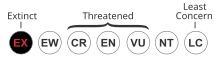
Extinct  (1662) (IUCN 3.1)[1]
Scientific classificationedit
Kingdom:Animalia
Phylum:Chordata
Class:Aves
Order:Columbiformes
Family:Columbidae
Subfamily:Raphinae
Genus:Raphus
Brisson, 1760
Species:
R. cucullatus
Binomial name
Raphus cucullatus
(Linnaeus, 1758)
Mauritius island location.svg
Location of Mauritius (in blue)
Synonyms
  • Struthio cucullatus Linnaeus, 1758
  • Didus ineptus Linnaeus, 1766

The dodo (Raphus cucullatus) is an extinct flightless bird that was endemic to the island of Mauritius, east of Madagascar in the Indian Ocean. The dodo's closest genetic relative was the also-extinct Rodrigues solitaire, the two forming the subfamily Raphinae of the family of pigeons and doves. The closest living relative of the dodo is the Nicobar pigeon. A white dodo was once thought to have existed on the nearby island of Rรฉunion, but this is now believed to have been confusion based on the also-extinct Rรฉunion ibis and paintings of white dodos.

Subfossil remains show the dodo was about 1 metre (3 ft 3 in) tall and may have weighed 10.6–17.5 kg (23–39 lb) in the wild. The dodo's appearance in life is evidenced only by drawings, paintings, and written accounts from the 17th century. As these vary considerably, and only some of the illustrations are known to have been drawn from live specimens, its exact appearance in life remains unresolved, and little is known about its behaviour. Though the dodo has historically been considered fat and clumsy, it is now thought to have been well-adapted for its ecosystem. It has been depicted with brownish-grey plumage, yellow feet, a tuft of tail feathers, a grey, naked head, and a black, yellow, and green beak. It used gizzard stones to help digest its food, which is thought to have included fruits, and its main habitat is believed to have been the woods in the drier coastal areas of Mauritius. One account states its clutch consisted of a single egg. It is presumed that the dodo became flightless because of the ready availability of abundant food sources and a relative absence of predators on Mauritius.

The first recorded mention of the dodo was by Dutch sailors in 1598. In the following years, the bird was hunted by sailors and invasive species, while its habitat was being destroyed. The last widely accepted sighting of a dodo was in 1662. Its extinction was not immediately noticed, and some considered it to be a myth. In the 19th century, research was conducted on a small quantity of remains of four specimens that had been brought to Europe in the early 17th century. Among these is a dried head, the only soft tissue of the dodo that remains today. Since then, a large amount of subfossil material has been collected on Mauritius, mostly from the Mare aux Songes swamp. The extinction of the dodo within less than a century of its discovery called attention to the previously unrecognised problem of human involvement in the disappearance of entire species. The dodo achieved widespread recognition from its role in the story of Alice's Adventures in Wonderland, and it has since become a fixture in popular culture, often as a symbol of extinction and obsolescence.

Saturday, April 3, 2021

a to z blogging challenge C is for Chinchilla


C is for Chinchilla 


Chinchillas are either of two species (Chinchilla chinchilla and Chinchilla lanigera) of crepuscular rodents of the parvorder Caviomorpha. They are slightly larger and more robust than ground squirrels, and are native to the Andes mountains in South America.[3] They live in colonies called "herds" at high elevations of up to 4,270 m (14,000 ft). Historically, chinchillas lived in an area that included parts of BoliviaPeruArgentina, and Chile, but today, colonies in the wild are known only in Chile.[4] Along with their relatives, viscachas, they make up the family Chinchillidae. They are also related to the chinchilla rat.

The chinchilla has the densest fur of all mammals that live on land. In the water, the sea otter has a denser coat.[5] The chinchilla is named after the Chincha people of the Andes, who once wore its dense, velvet-like fur.[6] By the end of the 19th century, chinchillas had become quite rare after being hunted for their ultra-soft fur.[7] Most chinchillas currently used by the fur industry for clothing and other accessories are farm-raised.[8] Domestic chinchillas descended from C. lanigera are sometimes kept as pets, and may be considered a type of pocket pet.


A to Z Challenge B is for Bison


B is for Bison


Bison are large, powerful hooved animals that live in herds. There are 2 species of bison. The American bison (Bison bison) lives in North America, where it is also known as a buffalo. The European bison (Bison bonasus) was hunted to extinction, and has since been reintroduced in Poland.

I live near an Indian Reservation who is bringing these beauties back from near extinction.   so cool to see them grazing, and watching them


A to Z April Challenge A Aurochs


The animals I have chosen is endangered 


A is for  Aurochs


Aurochs Facts

Name Of Young
Calves
Group Behavior
  • Herds
Fun Fact
The ancestor of all domesticated cattle!
Estimated Population Size
None
Most Distinctive Feature
Its impressive size
Habitat
Grasslands, floodplains, and light woodlands
Predators
Wolves and large cats
Diet
Omnivore
Favorite Food
Grass
Common Name
Aurochs
Location
Europe, Asia, and North Africa
Slogan
Extinct ancestor of all domesticated cattle!
Group
Cattle

Aurochs Physical Characteristics

Skin Type
Hair
Lifespan
Perhaps 20 years on average
Weight
Up to 1,360kg (3,000lbs)
Height
1.2m – 1.8m (4ft – 6ft)
Age of Sexual Maturity
A few years